Bridge and pavement sensors.
Infratico builds sensor systems for bridge structural health, pavement sensing, and embedded PEA monitoring.

Custom sensors for asset monitoring.
Sensor hardware supports continuous infrastructure monitoring, pavement instrumentation, and practical field deployment.
Self-powered monitoring inside smart structures.
Low-cost sensors embedded inside smart structures can support damage and mechanical-failure prognosis. Bridge deployments can harvest power from structural vibration.
Field installation context.
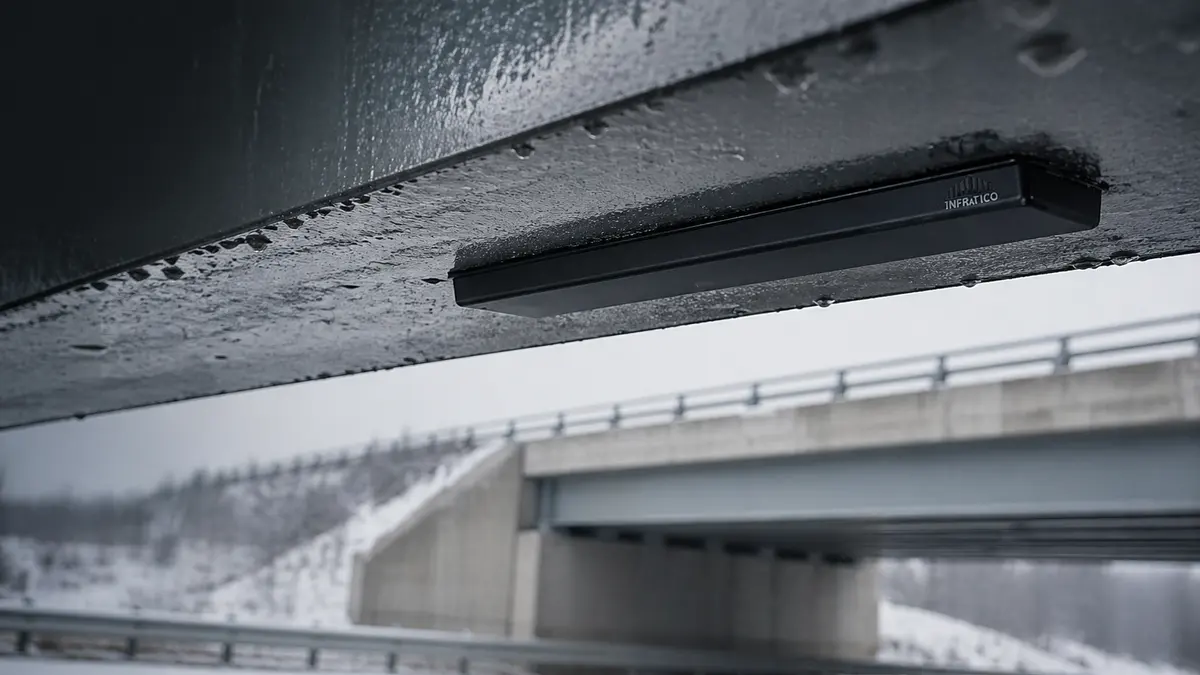
Quick installation takes only a few minutes per sensor. Prototype deployments are approaching their eighth year of operation.
PEA sensor specifications.
Self-powered operation
Low-cost sensors embedded inside smart structures can support damage and mechanical-failure prognosis. Deployed sensors target more than two decades of operation, with early prototypes approaching their eighth year in the field.
Edge classification
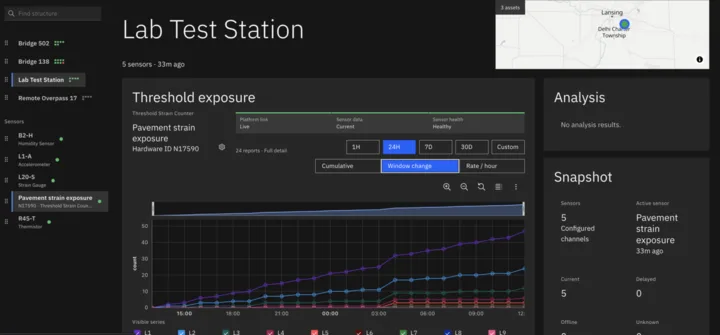
The self-powered approach harvests supplemental energy from the monitored structure itself. Each smart sensor can optionally use machine learning techniques to classify patterns within incoming physical stimuli.
Continuous monitoring
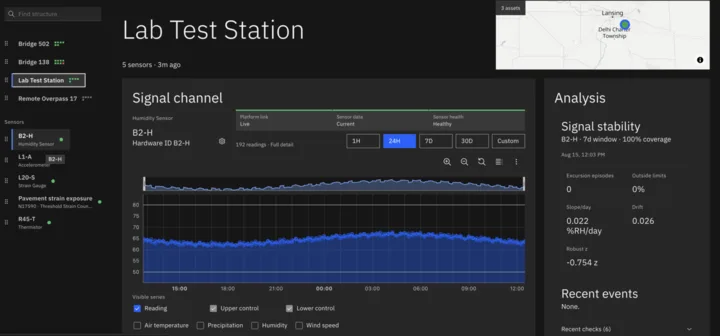
A self-powered analog electronic sensing element lets local sensor memory update without gaps caused by traditional ADC sampling limitations. The sensor updates data at effective sampling rates above 32 ksps.
Long-range wireless
Edge computing and local memory reserve more energy for long-range wireless communication. The system supports 50 km line-of-sight communication.
Wired or short-range wireless
The same sensor core can transmit data over wires or short-range wireless technologies such as backscattering.
Flexible form factor
For large-volume orders, the PEA sensor core can use a custom silicon die with a package size under 5 x 5 mm2.
Hardware for field environments.
PEA sensors handle tough field conditions and embedded monitoring use cases.
- Operational Lifespan
- 25 years
- Wireless Range
- 50 km line-of-sight
- Sensitivity (Strain)
- 5-12000 microstrain
- Effective Sampling
- 64 ksps
- Sensitivity (Acceleration)
- 0.005-32 g
- Local Data Storage
- 1,000 days